What We Have Learned
CalHOPE
〰️
CalHOPE 〰️
I want to learn more about…
How CalHOPE improved educators’ SEL skills and capacities
SEL Foundations: A graduate-level course offered at no cost to California classroom teachers, early and expanded learning professionals, and pupil services personnel that explores:
What systemic social and emotional learning (SEL) is.
Practical strategies to promote adult well-being and equitable, evidence-based SEL for youth.
Asset-based, accessible approaches to fostering positive relationships with students.
How these strategies can improve learning conditions across schools.
What We Have Learned
What happens when educators are given the opportunity to intentionally invest in their own social and emotional well-being?
In this study, 212 teachers participating in the SEL Foundations course helped researchers at UC Berkeley answer this question. Over three weeks, each educator implemented one or more Adult SEL practices in their own school or classroom, then reflected on what worked, what didn't, and what they learned along the way.
By analyzing their reflections and presentations, researchers identified five themes that capture how educators are putting Adult SEL into practice.
This paper also explores the successes, challenges, and adaptations teachers described as they navigated this work in real-world settings.
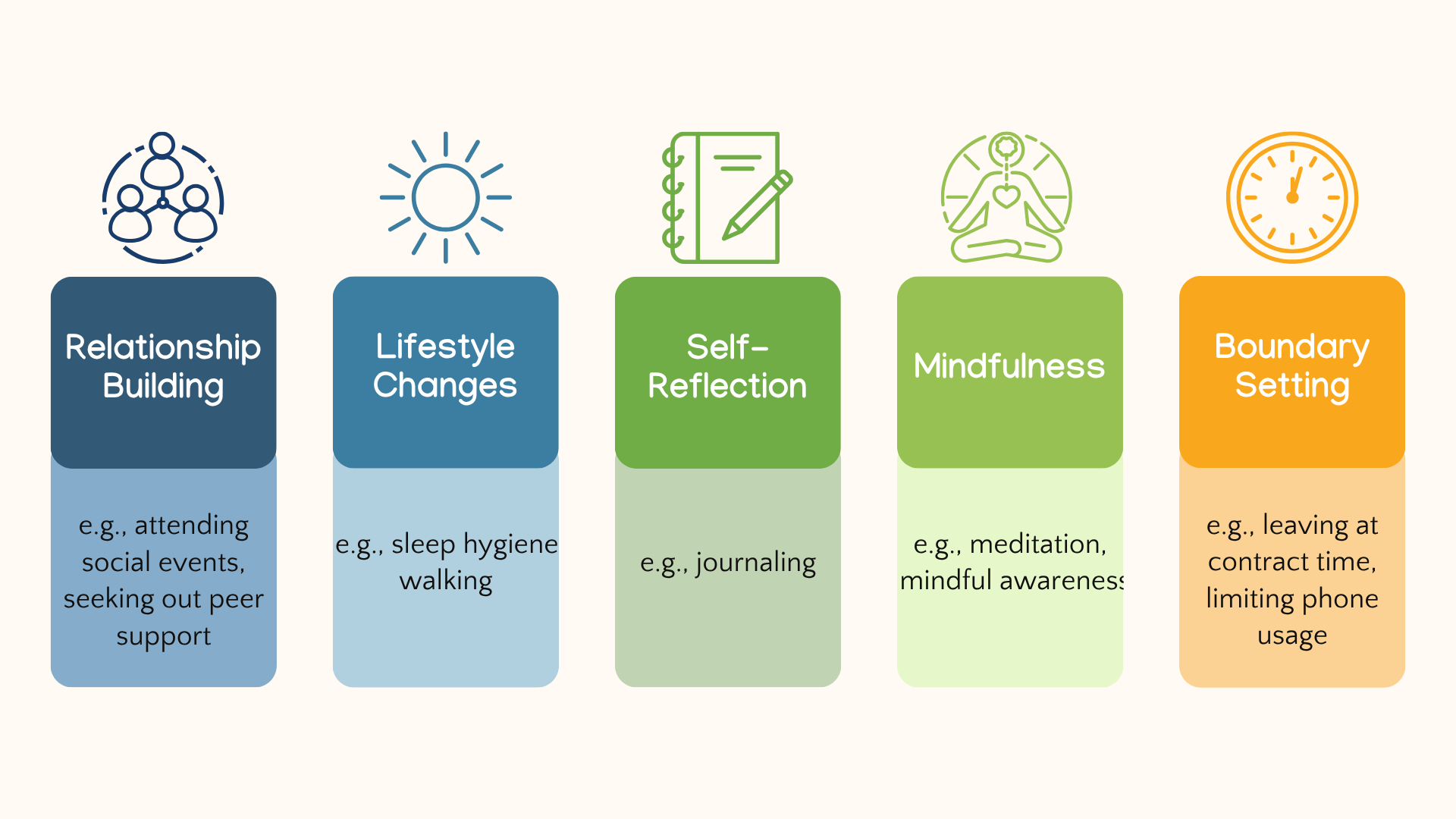
Together, these findings provide a window into how educators across a diverse range of settings and experiences approach strengthening their own social and emotional well-being and what they may need from schools, districts, and the broader SEL field to sustain these efforts over time.
Topics:
adult SEL, systemic SEL,
teacher well-being
How can educators strengthen their own social and emotional well-being to better support students?
Research Paper: “It All Starts with Us”: Exploring teachers’ efforts to increase Adult SEL in practice
Educators play a crucial role in students’ SEL, but few enter the teaching profession with opportunities to develop their own SEL knowledge and skills. The paper’s authors argue that continuing education and utilizing university partnerships may provide an important pathway for building educators’ SEL capacity as teacher preparation programs often provide limited focus on adult SEL.
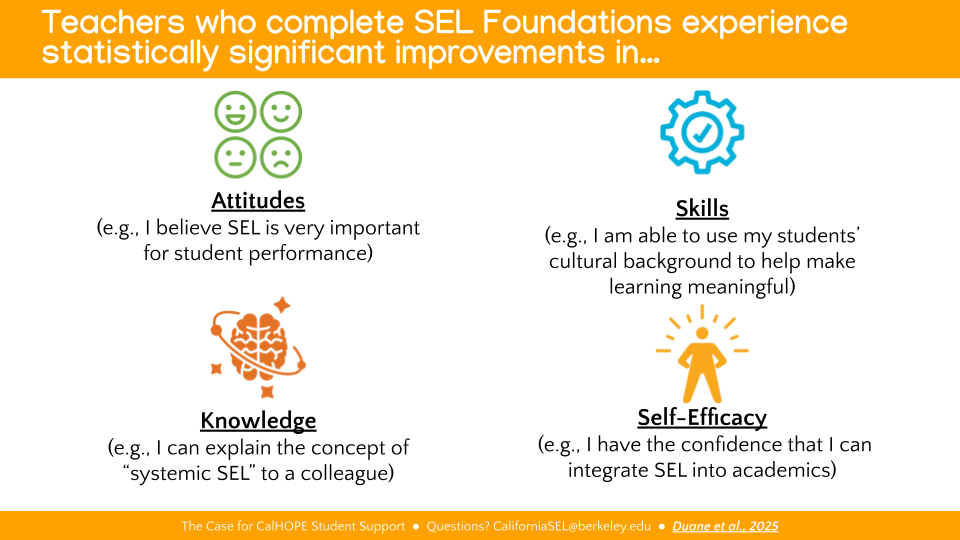
In this paper, researchers at the University of California, Berkeley followed PK - 12th grade educators enrolled in SEL Foundations, a graduate-level continuing education course that focuses on adult SEL. By comparing participants’ experiences before and after the course, researchers found meaningful improvements in educators’ perceptions of the support available to them as well as in the skills and confidence needed to implement SEL effectively in their classrooms.
These findings also suggest that continuing education focused on adult SEL, particularly through university settings, may benefit educators beyond professional growth by supporting their well-being.
Together, these results highlight the important role that universities can play as partners in preparing and supporting educators. They also suggest that expanding access to high-quality continuing education on adult SEL may help create positive and safe learning environments for both adults and students.
How can continuing education help educators build the skills and capacity to implement SEL with their students?
Research Paper: Securing the foundation: Providing supports and building teacher capacity for SEL implementation through a university-based continuing education course
What we learned:
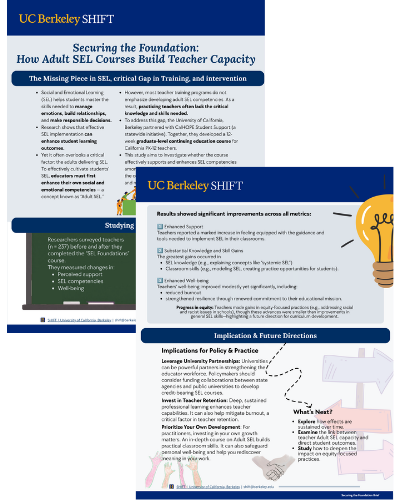
Continuing education focused on adult SEL increased educators’ capacity. After completing the course, educators reported greater confidence, SEL skills, and support for SEL implementation.
Focusing on adult SEL may also improve educator well-being. The benefits reported extend beyond instructional practices to
educators’ own sense of well-being.
Why it matters:
Educators need SEL too. If educators are to guide students’ social and emotional learning, then they need opportunities to build their social and emotional skills - something that preservice training programs may not provide.
Investing in adult SEL can strengthen implementation. Supporting educators’ well-being and confidence may improve both classroom practices and overall conditions for student learning.
Topics:
adult SEL, systemic SEL,
social and emotional learning,
equity, continuing education
What we learned:
Collaboration sustains the work. Peer coaching and collaborative professional learning emerged as essential supports, suggesting that teachers need structured opportunities to learn from and with each other.
Systemic support is non-negotiable. Teachers
described needing leadership backing, dedicated time for reflection, and access to SEL tools to embed adult SEL practices effectively across different school contexts.
Why it matters:
Teachers need space to practice what they teach. If educators are expected to model and guide students' social and emotional development, they need authentic opportunities to strengthen their own SEL skills within their daily work.
SEL works best when it's embedded. When teachers integrate SEL into academic instruction, it becomes sustainable and relevant rather than an additional burden on already full schedules.
How do teachers' mindsets and culturally relevant skills shape their approach to equity-oriented SEL?
In this study, researchers worked with K–12 teachers across elementary and secondary settings, combining quantitative surveys on teacher mindsets and culturally relevant practices with classroom observations and focus group discussions.
Findings showed that teachers with stronger growth mindsets and culturally relevant teaching competencies were significantly more likely to embed SEL that addressed equity and social justice rather than simply behavior management, but also critical engagement with identity, culture, and community. Teachers without specific training in culturally relevant skills tended to default to generic, one-size-fits-all approaches.
Topics:
social emotional learning,
culturally relevant and sustaining pedagogies, equity, skills, mindsets, academic integration
What makes some teachers naturally weave equity into their SEL practice while others struggle to move beyond surface-level implementation?
Research Paper: Linking Teacher Mindsets to Equity-Oriented SEL Integration: The Role of Teachers’ Culturally Relevant Skills.
What we learned:
Growth mindset enables equity-oriented SEL. Teachers who believed students could develop and grow were more likely to integrate SEL that challenged inequities rather than simply managing compliance.
Culturally relevant skills are foundational, not optional. Without training in culturally responsive practices, even well-meaning SEL efforts can miss the students who need them most.
Equity SEL drives measurable classroom outcomes. Implementation is associated with greater student engagement and fewer discipline incidents, particularly in diverse urban settings.
Why it matters:
SEL without equity skills falls short. Professional learning must build culturally relevant competencies alongside SEL knowledge—or implementation risks reproducing existing inequities.
Equity belongs at the foundation, not as an add-on. Connecting equity work to daily classroom practice is essential for serving all students effectively, especially in diverse communities.
In practice:
What would it take to embed culturally responsive and equity-focused
SEL practices into everyday instruction and professional learning?
In practice:
What would it take to make adult SEL a meaningful part of ongoing educator
professional development, and not just another initiative or one-time training?
In practice:
What are educators already doing together that could become
an opportunity to practice and strengthen adult SEL?
How CalHOPE improved system-wide conditions for SEL implementation
The Berkeley Assessment of Social and Emotional Learning (BASEL)
A practical, brief set of surveys to help SEL education leaders in counties, districts, and schools strengthen social and emotional learning (SEL) implementation. Designed for students, educators, and system leaders, the BASEL (pronounced “basil”) provides actionable insights that can be used to improve well-being, create more equitable learning environments, and guide SEL implementation over time.
The BASEL helps schools and researchers better understand:
Emotional well-being of leaders, students, and educators
Access to resources that support coping and resilience
Whether people feel safe, connected, and supported in their working and learning environments
Current and future opportunities for student voice, leadership, and meaningful participation in SEL implementation
How well schools create culturally and linguistically responsive learning environments
The implementation practices that support successful SEL school integration
What We Have Learned
How is California building the conditions for SEL to thrive statewide?
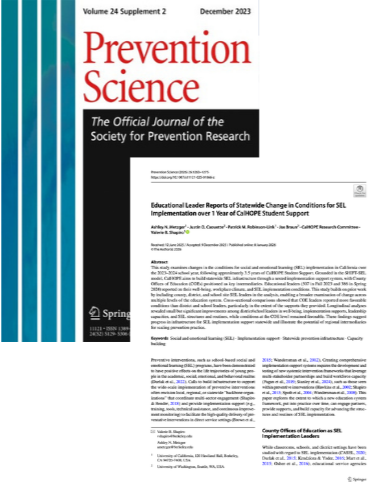
Research Paper: Educational Leader Reports of Statewide Change in Conditions for SEL Implementation over 1 Year of CalHOPE Student Support
How do we create the conditions for social and emotional learning (SEL) to thrive across multiple levels of the education system?
California’s CalHOPE was designed to answer that question by building statewide support for SEL implementation. Rather than treating SEL as a single program or classroom practice, CalHOPE focuses on strengthening the systems, relationships, and leadership needed to sustain SEL over time.
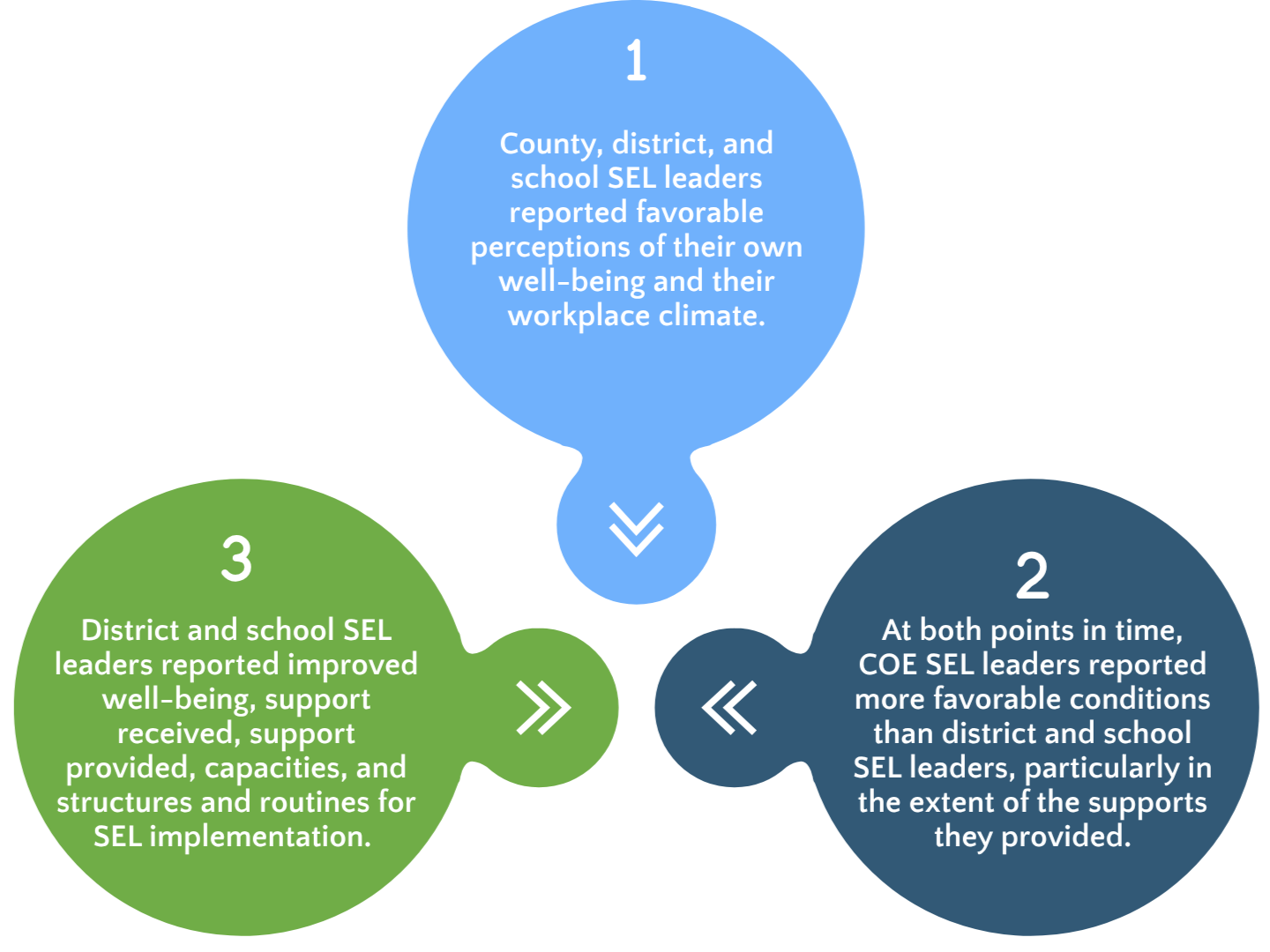
Findings indicate that CalHOPE built capacity on a statewide scale. In previous surveys, county leaders reported high levels of capacity, pointing to the positive conditions developed in the early days of CalHOPE.
Across the 2023 - 2024 school year, district and school leaders reported improvements across all dimensions of capacity, narrowing the gap between county-level and local SEL knowledge and skills and pointing to counties’ transfer of SEL implementation support. They also suggest that California’s statewide approach is strengthening the infrastructure needed for lasting SEL implementation.
Image 1. The SHIFT-SEL Model
Topics:
social and emotional learning, implementation support,
statewide prevention infrastructure, capacity building
What we learned:
SEL implementation capacity grew across
the state. District and school leaders reported improvements in capacity in the 2023 - 2024 school year.Capacity diffused from counties to local contexts. County leaders reported high levels
of capacity in earlier years, and now district
and school leaders were catching up,
suggesting a successful transfer of SEL implementation support.
Why it matters:
Statewide investment can build local
capacity. These findings suggest that a
coordinated statewide effort can support the
flow of implementation capacity from
intermediary organizations like County Offices
of Education to districts and schools.Sustainable SEL implementation depends
on systems. By focusing on organizational conditions, leadership, and adult SEL capacity, CalHOPE is creating the conditions needed for
SEL to endure beyond individual efforts.
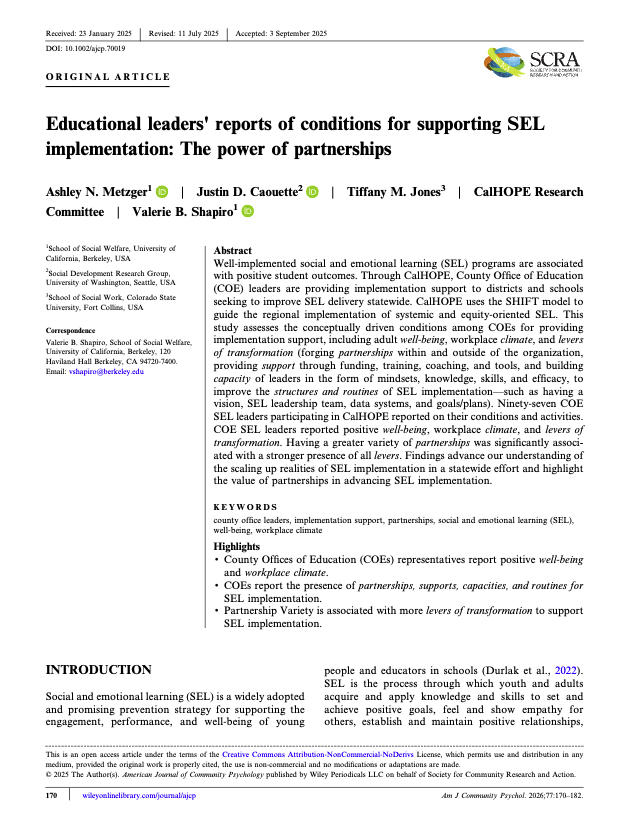
This study explored the experiences of County Office of Education (COE) SEL leaders who had participated in CalHOPE at any time since it began in 2021. Through survey responses, researchers sought to understand the conditions shaping COE leaders’ efforts to support statewide SEL implementation by exploring leaders’ well-being, workplace environments, organizational capacity to support SEL, and the role of partnerships in implementation.
Findings suggest that at this time point, 3.5 years into the CalHOPE project, many COEs had built strong foundational infrastructure for SEL implementation. Leaders reported supportive work environments, strong levels of SEL implementation capacities, and a range of implementation structures and supports to advance SEL.
Additionally, findings revealed that COEs had a variety of partnerships in place, most commonly with districts, schools, and school staff, divisions within the COE, and with community partners. They also revealed that counties with greater diversity in partnerships also reported stronger SEL implementation routines, higher levels of implementation support, and greater implementation capacities.
These findings highlight the importance of cultivating relationships and collaboration to support sustained and systemwide SEL implementation. Early CalHOPE efforts concentrated on partnerships, indicating that these initial investments yield positive returns as counties built out implementation systems.
Topics:
county office leaders,
implementation support, partnerships, social and emotional learning,
well-being, workplace climate
How do partnerships between schools and support organizations strengthen SEL implementation?
Research Paper: Educational leaders' reports of conditions for supporting SEL implementation: The power of partnerships
What we learned:
Regional intermediaries can anchor SEL infrastructure. COEs reported consistently favorable conditions for SEL implementation
3.5 years into CalHOPE, suggesting that
COEs serve as effective hubs for scaling SEL statewide.Progress is happening at district and
school levels. After one year (Fall 2023 to
Spring 2024), district and school leaders
showed small but statistically significant
gains in adult well-being, implementation
supports, leadership capacities, and SEL
structures and routines—indicating that
statewide efforts are rippling down to
local settings.Partnerships drive system transformation.
COE leaders reported an average of 5.5 partnerships, most commonly with school
districts, focal schools, community partners,
and teachers and staff. Those with more partnerships demonstrated stronger supports, capacities, and implementation structures, highlighting relationships as a key lever.
Why it matters:
Sustained funding enables sustained
progress. The measurable gains at district
and school levels after 3.5 years suggest
that long-term investment in SEL
infrastructure yields cumulative benefits.Equity must be named and tracked
explicitly. The lag in cultural responsiveness indicators signals that even well-supported
SEL systems can overlook equity dimensions
unless they are intentionally measured,
discussed, and prioritized alongside
implementation structures and leader
capacities.Partnerships are measurable and
actionable. Since partnership breadth
correlates with stronger SEL conditions,
districts and COEs can use the number and diversity of partnerships as a concrete
benchmark for tracking whether their SEL ecosystem is maturing over time.
California educators faced unprecedented challenges during the pandemic, with little guidance for aligning SEL efforts across the state's 58 counties and over 1,000 districts serving six million students. CalHOPE Student Support emerged as a statewide initiative partnering County Offices of Education (COEs), state agencies, and researchers to build infrastructure for systemic SEL implementation.
Through surveys of county education representatives and ongoing analysis, the project captured lessons from one of the largest multi-stakeholder SEL efforts in the U.S.
Topics:
county office leaders,
implementation support, partnerships, social and emotional learning,
well-being, workplace climate
How did California harmonize essential elementsinto a comprehensive system for statewide SEL implementation?
Research Paper: “We will build together”: Sowing the seeds of SEL statewide
What we learned:
Build capacity for change-making, not just SEL. Leaders needed skills to navigate the change process itself, including planning, implementation science, and adaptation strategies beyond SEL content knowledge.
Differentiate support based on starting points. Rural and urban counties had vastly different resources and priorities, requiring tailored "choose your own adventure" spaces.
Relationships sustain the work through turnover. Regular connection time, weekly office hours, and in-person gatherings maintained trust and engagement even as personnel moved between roles.
Why it matters:
Statewide SEL requires systemic coordination. Individual schools cannot drive transformation alone. Infrastructure, funding, and cross-sector partnerships are essential for scaling impact.
Adult well-being connects to system capacity. Educators need resources, training, and time to implement SEL effectively; without supporting the adults, student programs struggle to take root.
Equity must be woven into implementation processes. Initiatives that don't actively examine power dynamics and decision-making structures risk reproducing the inequities they seek to address.
In practice:
What infrastructure and supports are needed to sustain
SEL efforts beyond individual leaders or champions?
How can we implement SEL in a way that
is resilient to staff turnover and leadership changes?
In practice:
What strengths and structures are helping SEL become embedded
across our organization, and how can we build on them?
What existing relationships and partnerships can we leverage across levels,
departments, and groups to strengthen and sustain SEL?
In practice:
Who do we need to work with to create the conditions for sustainable SEL
implementation in our context? How can we continue to strengthen those partnerships?
Who is at the table in our SEL work, who is missing, and how might
expanding our partnerships strengthen our implementation?
“We will build together…
focusing not on a single program,
but on cultivating the conditions that allow social and emotional learning to grow.”
How CalHOPE created a statewide network of SEL leaders
Research shows that SEL has the greatest impact when it moves beyond individual classrooms and becomes a part of how schools and systems operate every day.
In California, County Offices of Education (COEs) play a critical role in making that kind of system-wide change possible. As regional partners supporting more than 1,000 K-12 school districts serving nearly six million students, COEs help connect schools with resources, guidance, and implementation support.
What We Have Learned
How did the CalHOPE statewide community of practice for County Office of Education representatives shape leaders’ understanding of social and emotional learning?
Research Paper: “I would add”: Educational Leaders’ Understanding of SEL During a Statewide Community of Practice
As County Office of Education (COE) representatives attended monthly communities of practice from January through July of 2021, researchers found a documented shift in how leaders conceptualize SEL.
When education leaders initially defined SEL they tended to speak to long-standing SEL definitions (e.g., CASEL competencies), and focused on individual student skills. When provided an opportunity to update their definitions, many leaders shifted to more systemic thinking and included more elements of equity.
This paper also explores what these shifts mean for SEL leadership and implementation support. The transition from "skills" to "systems" suggests that communities of practice can effectively expand leaders' perspectives, moving them from viewing SEL as a discrete program to recognizing it as embedded in all aspects of school climate, instruction, discipline, and family engagement.
Together, these findings underscore that how leaders define SEL directly shapes how they support implementation. When leaders understand SEL systemically—with attention to equity, adult capacity, and organizational structures—they're better equipped to allocate resources, build collaborative teams, and create conditions where sustainable implementation can take root. For practitioners and district leaders, this means investing in sustained professional learning spaces where SEL can be discussed, debated, and reframed alongside peer colleagues—not just trainings that deliver pre-packaged definitions or curricula.
Topics:
social and emotional learning,
educational leadership,
capacity building,
communities of practice, equity,
empirical paper
What we learned:
Educational leaders’ understanding of
SEL became more comprehensive.
Definitions evolved from viewing SEL as an
individual set of competencies to
understanding it as a systemwide approach.Leaders increasingly incorporated equity
into their thinking. After six months of
Community of Practice participation, leaders connected SEL to adult learning,
organizational culture and structures, and
equitable school conditions.Engaging in sustained, peer learning can
change how leaders conceptualize SEL implementation. The Community of Practice helped to redefine the way leaders thought
about SEL and how it works.
Why it matters:
How leaders define SEL shapes how they implement SEL. Leaders who have systemic
and equity-oriented SEL definitions shift
their priorities away from isolated programs
to organizational change.Shifting mindsets is an important part of
building sustainable large-scale
implementation structures. The conditions
and resources needed for implementation
depend not only on training, but also on
developing how leaders think about SEL.Communities of practice can build shared understanding. Bringing leaders together
may help them to align around a broader,
more equitable vision of SEL implementation.
How can education intermediaries translate their commitment to social and emotional learning into concrete goals?
Research Paper: Supporting the Implementation of Social and Emotional Learning: County Office Goals to Promote Wellbeing in Schools
In this study, researchers examined County Offices of Education (COEs) across California during the 2023-2024 school year to understand how they formulate and enact goals to embed SEL implementation in their organizational structures and routines. The team surveyed SEL coordinators and staff responsible for implementation support and analyzed their goals.
By examining both the prevalence and content of these goals, researchers found that nearly all counties (about 95%) had articulated specific goals for SEL support. The overwhelming majority concentrated on:
building regional infrastructure, such as data systems,
stewarding professional-development networks, and
improving coordination mechanisms that schools rely on to deliver SEL effectively.
A substantial portion of SEL leaders also emphasized strengthening adult SEL among teachers and administrators, recognizing that educator wellbeing directly impacts their ability to support students.
This paper also explores how COEs most frequently referenced two key domains: "building foundational support" and "strengthening adult SEL." For practitioners, this reveals that successful scaling depends less on individual classroom programs and more on coordinated infrastructure that provides districts and schools with the resources, training, and ongoing support they need.
Together, these findings underscore the need for coordinated large-scale SEL implementation: sustainable SEL requires aligned strategic plans, dedicated infrastructure, and sustained professional development. County offices that prioritize these structural supports create conditions where administrators and educators can thrive, and students benefit from consistent, high-quality SEL implementation.
Topics:
systemic social and emotional learning, implementation support,
capacity building, statewide approaches,
county office of education
What we learned:
Nearly all County Offices of Education (95%) made SEL a strategic priority. Counties
focused on building systems, professional
learning networks, and improving coordination across districts and schools rather than relying
on single classroom or school programs.Adult SEL was a key implementation priority. Many county SEL leaders emphasized
supporting educators’ social and emotional wellbeing as an essential component of their
SEL implementation strategies.County SEL goals focused on building
sustained implementation capacity. County
goals most often prioritized long-term
investments rather than intermittent programs.
Why it matters:
Strong implementation depends on
systemic efforts. Investing in infrastructure
and professional development helps districts
and schools deliver SEL more consistently and effectively.Supporting educator SEL strengthens
support for students. Prioritizing adult SEL
helps to equip administrators and educators to create healthier learning environments and to sustain SEL implementation.Sustained organizational investment is
critical for system-wide change. Setting implementation goals focused on planning,
ongoing professional development, and
dedicated coordination create the conditions
for high-quality, sustainable SEL implementation.
In practice:
How might our understanding of SEL shape the decisions,
priorities, and conditions we create for implementation?
Does our current thinking about SEL support sustainable organizational change?
If not, what might we need to shift?
In practice:
What organizational structures, resources, and supports are in place,
and what is needed to make SEL a lasting priority?
Where are we investing in long-term SEL capacity, and where
might we still be relying on short-term efforts?